The Seventh Cloud: Death

Translate this blog to: Français,Deutsch,Spanish and more!

Showing posts with label Death. Show all posts

Monday, May 25, 2026

From Canvas to Camera: The Accessibility of Memorial Art


Before the advent of photography, the ability to preserve a loved one’s likeness either in life or in death was a privilege reserved for royalty and the wealthy, who could commission expensive oil paintings to immortalize their lives. When the daguerreotype was first introduced, it remained a significant investment. However, many families who could not otherwise afford a portrait made a rare financial exception upon the passing of a family member.

These memorial images were not always solitary portraits. It was common for the deceased to be included in a "final family reunion" within a garden, around a dining table, or in the family living room, documenting the complete family unit one last time.

The Museum of Mourning Photography & Memorial Practice archive is an investigation into human ritual.


The practice of gathering for a final family reunion became deeply significant, leading families to do so when facing a time of loss/ During the Victorian Era, this custom was culturally accepted and perhaps even expected by society.

As previously explained in other posts, ordinary families could not always afford to hire a photographer to document life, but death was a serious matter. This is why we usually see post-mosrtem photos of older individuals or youg children.

Just as you would if you were sitting for a painted portrait, decisions were made about how the deceased would pose. Looking at photographs from that era, we see some subjects placed inside a coffin surrounded by flowers, others resting on a bed surrounded by family members and some even posed in a lifelike manner. 


When I first heard about Mortuary photography , which was back in 2001 when I first saw the movie: The others ( I would recommend to see it) , I was absolutely fascinated. Throughout the years, I have looked at more and more of these photos, but just everything else in real life and online, there are fake photos out there. I previously shared some of these images because I am no expert and I used to trsut "the Almighty internet" thinking that if it was online, it had to be real. It turns out, that isn't always the case. Please forgive me if I still do so, although I will try to look harder for better examples. 


A memorial photograph is usually legitimate when:

  • The mortal remains are inside a coffin.

  • The deceased is surrounded by flowers and a cross (or other religious artifacts).

  • The deceased is surrounded by people and has their eyes closed and mouth slightly open while laying back (which would look unnatural if they were standing or sitting in a chair like everyone else).

  • The people surrounding the departed are dressed in black.

  • The subject is in a cemetery or next to a grave, surrounded by a group just before burial.

  • The subject has eyelids painted to look like open eyes, but you can easily tell they are not real.


Those are the usual telltale signs when determining if a death photograph is the real deal.Why people lie about which photos are Remembrance photography? Some people don't know, some people are just interested in the story and how interesting these images are and some are just interested in selling these photos as curiosities, even if they are photos of living people. 


Please leave a comment. I love to hear your thoughts. 


Some photography sources: 
https://clements.umich.edu/exhibit/death-in-early-america/post-mortem-overview/


Tuesday, April 14, 2015

Goth Problems


• Melting in the sunlight
• Summer
• Having no money in October
• When you run out of black makeup
• When your blacks don’t match
• People calling you emo
• When people assume you’re a satanist
• When your favorite band isn’t available on iTunes


Thursday, March 26, 2015

Victorian Remembrance: The Art of Post-Mortem Photography (Pt. 3)


  Post-Mortem Photography: A Historical and Cultural Ritual of Grief ( Pt 4 ) HERE

Historical Context: Maternal and Infant Remembrance

In the 19th and early 20th centuries, the mortality rates were a universal concern. Unlike many other health challenges of the era that followed a period of illness, maternal mortality often affected healthy young women unexpectedly. These events were deeply felt, frequently leaving families to navigate the complexities of grief while caring for newborns and older siblings.

The Role of Commemorative Photography

To honor the brief lives of infants lost during this era, families often turned to commemorative photography. In an age before personal cameras were common, these portraits represented a significant sacrifice and a profound act of love. These images served as a vital "memento mori," providing the only visual record a family would ever have of their child—a way to preserve their memory and place within the family tree forever.

Cultural and Religious Reflections

The gravity of these events was even woven into the social fabric of the time. For instance, the Church of England’s prayer book long included a specific service for the "Churching of Women." This rite, which has only recently been phased out, traditionally began by offering thanks for a mother’s survival and recovery, illustrating just how precarious the journey of parenthood was considered to be:.

The decline of post-mortem photography was not a sudden event but a gradual shift that began in the late 19th century and was largely complete by the 1930s.
   
‘The safe deliverance and preservation from the great dangers of childbirth.’


  Post-Mortem Photography: A Historical and Cultural Ritual of Grief ( Pt 4 ) HERE


Historical Metrics in Maternal Healthcare (1800–1950)

For over a century and a half, maternal health outcomes served as the primary benchmark for evaluating the efficacy of maternity services. These figures were scrutinized by obstetricians as they sought to improve clinical standards. However, defining the parameters of these statistics presented significant challenges for early medical professionals.

The Evolution of Data Collection

Before the mid-19th century, obtaining accurate population data was a complex task due to the lack of a centralized national registry. Prior to the landmark Registration of Deaths Act of 1837, historians and medical researchers had to rely on localized "bills of mortality" or parish registers. These early records, while invaluable, highlight the transition toward the rigorous, data-driven healthcare systems we recognize today.


The American Demographic Transition (1800–1950)

Like all modern, developed nations, the United States underwent a profound demographic transition from high to low levels of fertility and mortality. In the early 19th century, the average American woman experienced between seven and eight live births, while average life expectancy typically remained under forty years.

However, the American experience was unique for three reasons:

  1. An Early Shift: The decline in fertility rates began exceptionally early, starting in the late 18th or early 19th century. In contrast, most Western nations—excluding France—did not see sustained declines until the late 19th or early 20th century.

  2. A Unique Sequence: Unlike the typical demographic model where mortality rates drop first, America’s fertility decline preceded its mortality decline. A sustained, irreversible downward trend in mortality did not begin until approximately the 1870s.

  3. Migration and Expansion: These shifts were uniquely shaped by high levels of net in-migration and significant population redistribution, first toward the frontier and later into rapidly growing urban and suburban centers.


Wednesday, March 25, 2015

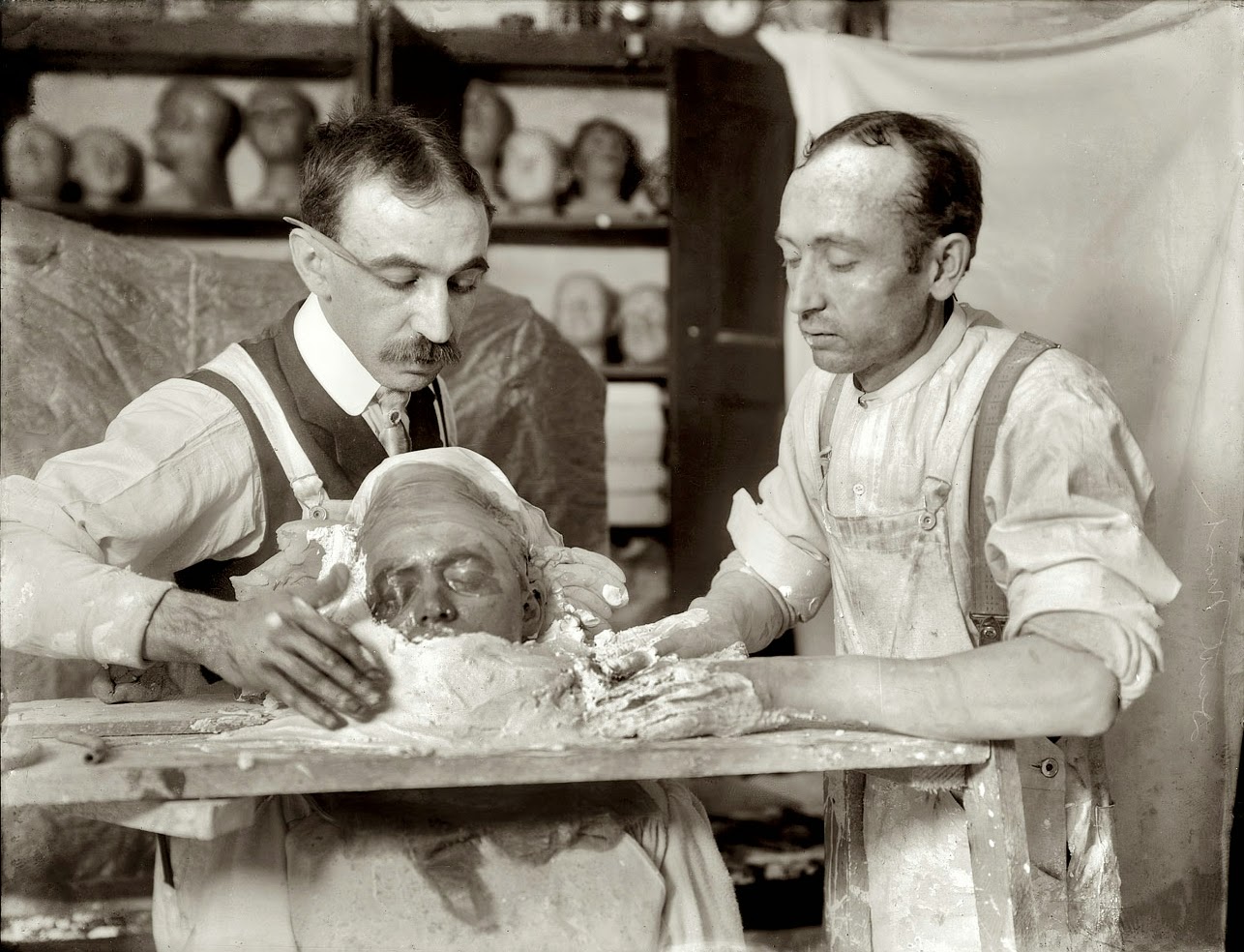
The Final Impression: The Art and History of the Death / Remembrance Mask


 I often find myself reflecting on the ways 

we remember those who came before us. 

Before the convenience of digital photography 

and instant portraits, the world had a much 

more tactile way of preserving a legacy.


I honestly wouldn't have minded if my great-grandparents had left me such a unique piece of history, a final casting to ensure their features were never forgotten. In the era before the camera, saying, 'I leave my likeness to my granddaughter,' was a profound act of love and preservation.

It’s fascinating to think that these masks weren't seen as somber objects, but as a way to bridge the gap between generations. In a time when a painted portrait was a luxury for the few, a hand-cast mask was a raw, honest, and permanent way to say, 'This is who I was.' While we now have thousands of photos on our phones, there is something deeply moving about the idea of a physical heirloom that you could actually touch to remember a face.


Historically, the remembrance mask served as a profound bridge between life and legacy. These unique artifacts were created by taking a direct cast of a person’s features, typically using materials like wax, bronze, or most commonly, plaster.

These casts served several important artistic and commemorative purposes:

  • Busts and Sculptures: Artists used them as a precise reference to create lifelike statues and monuments.

  • Historical Record: They offered a way to "immortalize" a person’s likeness with a level of detail that even the finest paintings couldn't match.

  • Family Heirlooms: These masks were often kept by families as a physical connection to their ancestors, sometimes even being displayed during memorial services as a tribute to the life lived.


From the Middle Ages through the early 20th century, creating these likenesses was a respected tradition often facilitated by skilled artisans. However, as portrait photography became more accessible, this tactile method of preservation gradually transitioned from a common practice into a rare, historical art form.


“In the cases of people whose faces were damaged by their death, it was common to take casts of their hands. An example of this occurred in the case of Thomas D'Arcy McGee, the Canadian statesman whose face was shattered by the bullet which assassinated him in 1868.” - Wikipedia

While life masks were often created from living subjects, the remembrance mask presented a unique challenge for artisans. Sculptors and specialists understood that timing was essential to capture a true-to-life impression. To preserve the most natural facial structure and authentic features, the cast had to be created swiftly, ensuring the final work reflected the person's true character before the subtle details of their likeness began to shift or decay.


Thanks to this dedication to preservation, the likenesses of many historical figures have been immortalized, allowing us to view faithful replicas of their actual features today. Even modern forensic science has benefited from these masks, as they allow researchers to meticulously study a subject’s facial structure centuries later. While the original molds are typically protected within museum archives, the versions we see on display are carefully crafted copies. It is often noted that only a handful of these authentic, early-edition casts exist worldwide, each dating back decades or even centuries. Standing face-to-face with a remembrance mask provides a sense of realism that a painting or a sketch simply cannot capture. 

(Romans and Ludwig Van Beethoven)


   (Marie Antoinette and  Henry IV of France)


(Alfred Hitchcock) 


Mary Queen of Scots and Nikolai Tesla


( Pancho Villa )


( W. Shakespeare )

 ( Sir Isaac Newton )


( Frederick II, King of Prussia )

( George Washington )


Would do like to have your own Life or Death mask ? Why ?

ad