The Seventh Cloud: Dead People

Translate this blog to: Français,Deutsch,Spanish and more!

Showing posts with label Dead People. Show all posts

Monday, May 25, 2026

From Canvas to Camera: The Accessibility of Memorial Art


Before the advent of photography, the ability to preserve a loved one’s likeness either in life or in death was a privilege reserved for royalty and the wealthy, who could commission expensive oil paintings to immortalize their lives. When the daguerreotype was first introduced, it remained a significant investment. However, many families who could not otherwise afford a portrait made a rare financial exception upon the passing of a family member.

These memorial images were not always solitary portraits. It was common for the deceased to be included in a "final family reunion" within a garden, around a dining table, or in the family living room, documenting the complete family unit one last time.

The Museum of Mourning Photography & Memorial Practice archive is an investigation into human ritual.


The practice of gathering for a final family reunion became deeply significant, leading families to do so when facing a time of loss/ During the Victorian Era, this custom was culturally accepted and perhaps even expected by society.

As previously explained in other posts, ordinary families could not always afford to hire a photographer to document life, but death was a serious matter. This is why we usually see post-mosrtem photos of older individuals or youg children.

Just as you would if you were sitting for a painted portrait, decisions were made about how the deceased would pose. Looking at photographs from that era, we see some subjects placed inside a coffin surrounded by flowers, others resting on a bed surrounded by family members and some even posed in a lifelike manner. 


When I first heard about Mortuary photography , which was back in 2001 when I first saw the movie: The others ( I would recommend to see it) , I was absolutely fascinated. Throughout the years, I have looked at more and more of these photos, but just everything else in real life and online, there are fake photos out there. I previously shared some of these images because I am no expert and I used to trsut "the Almighty internet" thinking that if it was online, it had to be real. It turns out, that isn't always the case. Please forgive me if I still do so, although I will try to look harder for better examples. 


A memorial photograph is usually legitimate when:

  • The mortal remains are inside a coffin.

  • The deceased is surrounded by flowers and a cross (or other religious artifacts).

  • The deceased is surrounded by people and has their eyes closed and mouth slightly open while laying back (which would look unnatural if they were standing or sitting in a chair like everyone else).

  • The people surrounding the departed are dressed in black.

  • The subject is in a cemetery or next to a grave, surrounded by a group just before burial.

  • The subject has eyelids painted to look like open eyes, but you can easily tell they are not real.


Those are the usual telltale signs when determining if a death photograph is the real deal.Why people lie about which photos are Remembrance photography? Some people don't know, some people are just interested in the story and how interesting these images are and some are just interested in selling these photos as curiosities, even if they are photos of living people. 


Please leave a comment. I love to hear your thoughts. 


Some photography sources: 
https://clements.umich.edu/exhibit/death-in-early-america/post-mortem-overview/


Friday, October 2, 2015

Halloween is everyday


Halloweenophile

This follows the classic Greek suffix -phile (meaning "lover of"). It’s the most common term you'll find in online communities and among die-hard fans of the spooky season.

Fun Fact: If you are one of these people who keeps the decorations up until December, you might be part of the "Summerween" or "Creepmas" subcultures, where Halloween is a lifestyle rather than just a day.

I love mainly love Halloween because people like me are visible and everything is Halloween land ( depending on where you live) . In my town there are some places that decorate accordingly, there are parties, theme foods and scarry movies on TV.


Tuesday, April 14, 2015

Goth Problems


• Melting in the sunlight
• Summer
• Having no money in October
• When you run out of black makeup
• When your blacks don’t match
• People calling you emo
• When people assume you’re a satanist
• When your favorite band isn’t available on iTunes


Wednesday, March 25, 2015

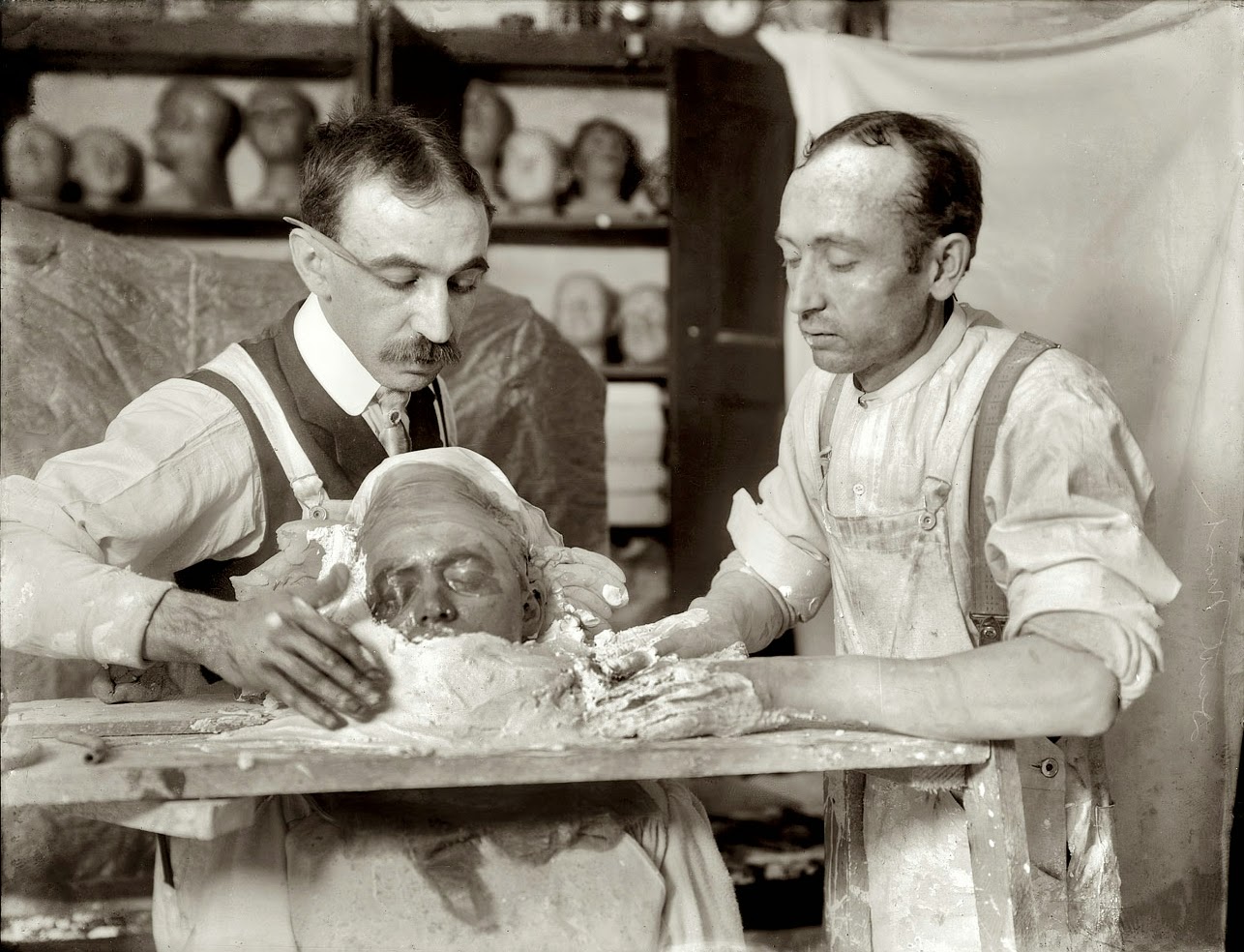
The Final Impression: The Art and History of the Death / Remembrance Mask


 I often find myself reflecting on the ways 

we remember those who came before us. 

Before the convenience of digital photography 

and instant portraits, the world had a much 

more tactile way of preserving a legacy.


I honestly wouldn't have minded if my great-grandparents had left me such a unique piece of history, a final casting to ensure their features were never forgotten. In the era before the camera, saying, 'I leave my likeness to my granddaughter,' was a profound act of love and preservation.

It’s fascinating to think that these masks weren't seen as somber objects, but as a way to bridge the gap between generations. In a time when a painted portrait was a luxury for the few, a hand-cast mask was a raw, honest, and permanent way to say, 'This is who I was.' While we now have thousands of photos on our phones, there is something deeply moving about the idea of a physical heirloom that you could actually touch to remember a face.


Historically, the remembrance mask served as a profound bridge between life and legacy. These unique artifacts were created by taking a direct cast of a person’s features, typically using materials like wax, bronze, or most commonly, plaster.

These casts served several important artistic and commemorative purposes:

  • Busts and Sculptures: Artists used them as a precise reference to create lifelike statues and monuments.

  • Historical Record: They offered a way to "immortalize" a person’s likeness with a level of detail that even the finest paintings couldn't match.

  • Family Heirlooms: These masks were often kept by families as a physical connection to their ancestors, sometimes even being displayed during memorial services as a tribute to the life lived.


From the Middle Ages through the early 20th century, creating these likenesses was a respected tradition often facilitated by skilled artisans. However, as portrait photography became more accessible, this tactile method of preservation gradually transitioned from a common practice into a rare, historical art form.


“In the cases of people whose faces were damaged by their death, it was common to take casts of their hands. An example of this occurred in the case of Thomas D'Arcy McGee, the Canadian statesman whose face was shattered by the bullet which assassinated him in 1868.” - Wikipedia

While life masks were often created from living subjects, the remembrance mask presented a unique challenge for artisans. Sculptors and specialists understood that timing was essential to capture a true-to-life impression. To preserve the most natural facial structure and authentic features, the cast had to be created swiftly, ensuring the final work reflected the person's true character before the subtle details of their likeness began to shift or decay.


Thanks to this dedication to preservation, the likenesses of many historical figures have been immortalized, allowing us to view faithful replicas of their actual features today. Even modern forensic science has benefited from these masks, as they allow researchers to meticulously study a subject’s facial structure centuries later. While the original molds are typically protected within museum archives, the versions we see on display are carefully crafted copies. It is often noted that only a handful of these authentic, early-edition casts exist worldwide, each dating back decades or even centuries. Standing face-to-face with a remembrance mask provides a sense of realism that a painting or a sketch simply cannot capture. 

(Romans and Ludwig Van Beethoven)


   (Marie Antoinette and  Henry IV of France)


(Alfred Hitchcock) 


Mary Queen of Scots and Nikolai Tesla


( Pancho Villa )


( W. Shakespeare )

 ( Sir Isaac Newton )


( Frederick II, King of Prussia )

( George Washington )


Would do like to have your own Life or Death mask ? Why ?

Wednesday, March 18, 2015

I'm dead and I'm here ! Headstones: Why Cemeteries Are the Last Witnesses of Our Existence


The headstone/gravestone marks the place where a grave or tomb is placed. They are traditionally used by most religious people and they became part of the funerary tradition and business. The gravestone is the way a family honors the deceased by putting this eternal memorial on“the last place to rest”. This is a tradition that I think we should keep alive.


Just think about it, from here to a hundred years, future generations will probably find our destroyed coffins, our bodies… bones and wonder if we were male or female?, who we were?, when did we died? and more. Part of the objective of the gravestones is not only for ID purposes (so the family can visit the body without forgetting the place) but because the human being has a fear to be forgotten. For most of us, documentation and a gravestone will be the only proof for the next generation that we existed once upon a time.


Most of the world’s population won’t enjoy a massive popularity, not even in their hometown but we will have a family that will remember and have us present in every important milestone in their life but if we are truly lucky, there will be someone who will want to know more about us even after we are gone.


When people started to make headstone, they started out by making them from simple materials and simple designs with symbolisms. From pieces of stone to carved wood, we manage to level up this important cemetery piece. In the old, old days when body snatching was fashionable; families even built cages on top of the graves.


Headstones nowadays are made from different materials: Fieldstones, Granite, Marble and Slate.  In the beginning all tombs had a stone lid, if the coffin was completely made of stone or not, this stone lid was placed over the grave. Stones were used to mark where a body was buried; they were placed around the grave and just marked with a name or initials (that's sad).


One important element on a headstone is the identification of the deceased person, the day of birth and death, a prayer or specials words by the family, a photo and finally a place to put flowers. Most people decides to put a little fence or something to surround the grave this way other cemetery visitors won’t step on a person’s last resting place.


Having a gravestone was and still is a symbol of wealth, the bigger the better. Some people used to buy expensive material and used designs that become traditional but were very symbolic, like skulls, birds, angels, flowers, praying hands, crosses, etc. The headstone evolved into pieces of art. Big or small, the sculptures that some graves have are beautiful and incredible. If you take a walk on a graveyard you will see sculptures of angels, Saints, hands, books, beds, Greek columns and more.


Sadly, there are more and more people going for cremation “Today, nearly all of the deceased receive some sort of burial or cremation even if it is paid for by the state. The cost of land and the current overcrowding in cemeteries, along with changes in perception, have made people consider cremation.  Cremations are less expensive than the cost of caskets and plots.” -247wallst . 
 I say sadly because XXI century people are opposite to the way The Victorians were during the 1800’s (Click to read more) ; people now hate death, they don’t want to talk about it, it’s scary and a morbid issue that shouldn’t be a topic of conversation…at all! So with that mindset, the sooner a body goes underground and if people don’t have to deal with a corpse THE BETTER! Cremation means that families won’t have to set a foot on a graveyard and that means that there will be one less proof of a person existing or worst; the neglect of cemeteries. Let’s face it, yes…we will have photos, facebook profiles and documents but none of them will truly express the love of a mourning family for the decease the way a headstone does. It will have a direct effect on people's way to see death; probably it will make people colder. Where our feelings will go if we cannot mourn in a place made for that?


ad